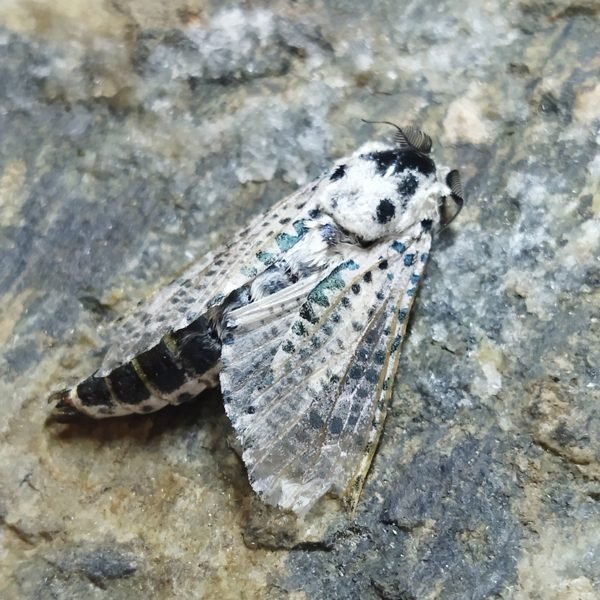
Leopard moth
Wood-boring caterpillars of two large moths: the leopard moth (Zeuzera pyrina) and the goat moth (Cossus cossus). They tunnel inside branches and trunks of fruit, olive, walnut and many other trees.
How to recognise
Wilting, yellowing or broken young shoots and branches. Round holes in twigs and trunks with sawdust-like frass pushed out, sometimes bound with silk. Leopard moth caterpillars are yellowish with black dots, up to 5 cm; the goat moth caterpillar is red-brown, up to 10 cm, and smells strongly of vinegar. The adult leopard moth is white with black spots.
Causes & conditions
Females lay eggs in bark cracks in summer. Caterpillars live inside the wood for one to three years (goat moth longer). Weak, wounded or neglected trees and young orchards with poor pruning are attacked most.
What to do
- Prune out and burn wilted shoots in autumn and winter.
- Probe the tunnel with a stiff wire to kill the caterpillar, or inject a beneficial nematode suspension (Steinernema or Heterorhabditis) into fresh holes and plug them.
- Keep trees vigorous with compost, mulch and balanced watering.
- Woodpeckers and other birds help: leave nest sites.
- Trap males with pheromone traps in summer to monitor, though traps alone do not remove the problem.
- Spray Bt (Bacillus thuringiensis) or neem leaf and seed extract (Neem leaf & seed extract) on young caterpillars, set pheromone traps (Sticky & pheromone traps), cover crops with Row covers & barriers, and release parasitic wasps (Trichogramma wasps) or insect-killing fungi (Beauveria & Metarhizium (insect-killing fungi)).
Cautions
Heavily infested trunks are weak and may snap in wind; remove them. Burn pruned wood rather than stacking it near orchards. Leopard moth is mainly a problem on young trees.
Photos