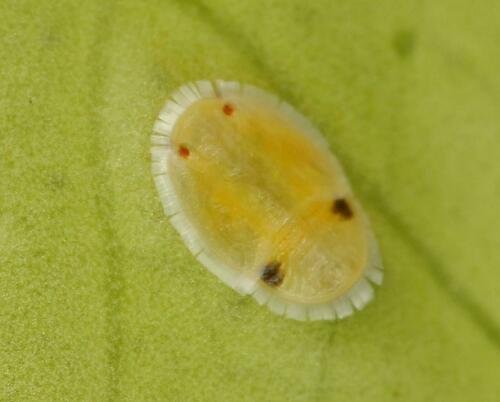
African citrus psyllid (Q)
Small sap-sucking insect of citrus that spreads African citrus greening, a bacterial disease. It is a quarantine pest in the Mediterranean region and is established in parts of Spain and Portugal. It sits next to the Asian citrus psyllid (Asian citrus psyllid).
How to recognise
Leaves with small round pits on the underside and matching bumps on top; curled, puckered young leaves; flat, scale-like nymphs in the pits; small brown-green winged adults on new shoots.
Causes & conditions
Cool, moist, mild climates and new growth flushes; moved on infested plants and cuttings, especially curry leaf and citrus bought from outside.
What to do
- Inspect new flushes often.
- Remove and destroy affected shoots.
- Encourage the parasitic wasp Tamarixia dryi, ladybirds and lacewings.
- Avoid excess nitrogen that drives soft flushes.
- Spray Kaolin clay film on new growth or Insecticidal soap on nymphs.
- Spray Insecticidal soap, Horticultural & neem oil (Horticultural & Horticultural & neem oil) or Garlic-chili spray, and release or attract ladybirds and lacewings (Ladybirds & lacewings) and Predatory mites.
- Sticky traps (Sticky & pheromone traps) catch adults, and Kaolin clay film deters them.
- Fermented herbal tonic (OHN) (Fermented herbal tonic (Fermented herbal tonic (OHN))) keeps plants vigorous.
Cautions
Quarantine pest in many countries: do not move citrus plants or cuttings from infested areas, and report suspected finds to the plant-protection service. Where the pest is established, planting rules may apply.
Photos