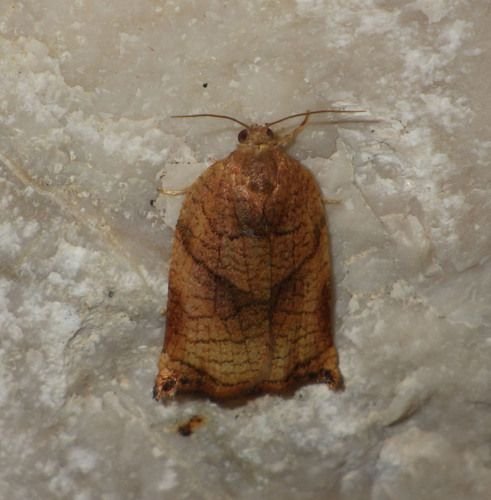
Leafroller moths
Archips rosana, Pandemis spp., Adoxophyes orana
Group of small tortricid moths whose caterpillars roll or web leaves together and feed inside; some also scar fruit. Includes the rose tortrix, Pandemis species and the summer fruit tortrix.
🌿Remedios naturales
📅CuándoWinter (eggs); spring bud burst; summer generations
🌾CultivosApple, pear, hazelnut, grape, rose, stone fruit, many ornamentals
Cómo reconocerlo
Leaves rolled or folded with silk and a green or brown caterpillar inside; shallow, corky scars on fruit; chewed buds and flower clusters in spring; the caterpillar wriggles backwards when disturbed.
Causas y condiciones
Overwinter as eggs on bark or as tiny larvae under bark scales and in buds. One to three generations a year. Worse in neglected orchards with dense canopies and many wild hosts nearby.
Qué hacer
- Squash rolled leaves by hand on small trees.
- Hang pheromone traps to monitor.
- Spray dormant oil (Aceite hortícola y aceite de neem) in winter on eggs.
- Spray Bt (Bacillus thuringiensis) on young larvae before they roll the leaves.
- Prune for open canopies and encourage birds and parasitic wasps with flowering strips.
- Spray Bt (Bacillus thuringiensis) or neem leaf and seed extract (Extracto de hoja y semilla de neem) on young caterpillars, set pheromone traps (Trampas adhesivas y de feromonas), cover crops with Mantas y barreras, and release parasitic wasps (Avispillas Avispillas Trichogramma) or insect-killing fungi (Beauveria y Metarhizium (hongos entomopatógenos)).
Precauciones
Dormant oil can burn buds once they swell; use it only before bud burst.
Fotos