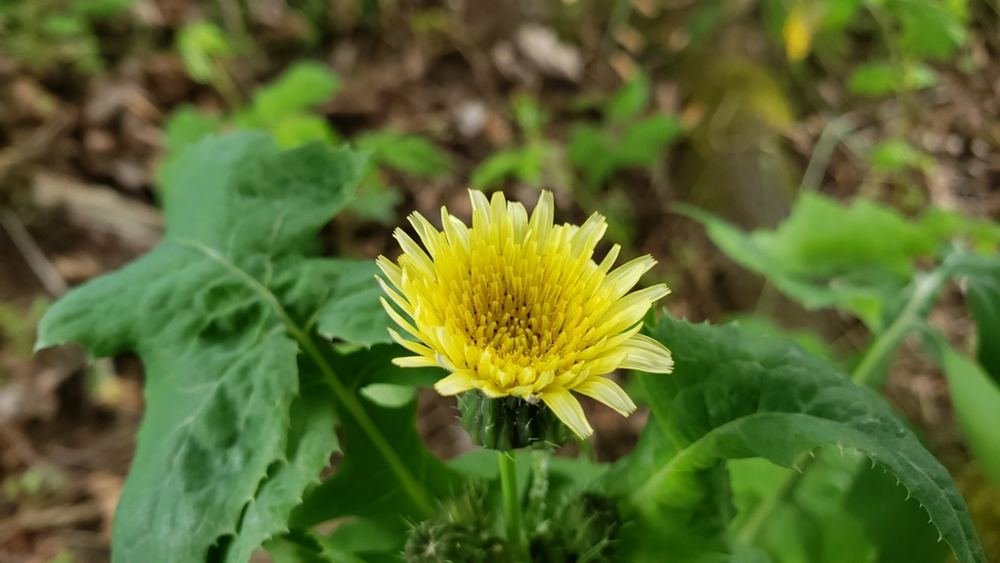
Sowthistles
Group of dandelion-like weeds with milky sap; the annual species are edible greens and animal feed, while field sowthistle is a rhizomatous perennial.
How to recognise
Hollow stems with milky latex; deeply lobed leaves clasping the stem, soft in common sowthistle (S. oleraceus) and prickly in spiny sowthistle (S. asper); yellow dandelion-like flowers that turn into white fluffy seed heads. Field sowthistle (S. arvensis) is taller with large flowers and creeping roots.
What it tells you about your soil
Fertile, disturbed, moist soil; common in gardens, orchards and cereals, along paths and in cracks.
Natural control
- Hoe or pull annual plants before flowers open; once flowers are open the seed can still ripen on the cut plant, so remove them.
- Mulch thickly.
- For field sowthistle, repeated cultivation and cutting every few weeks exhausts the roots over a season or two; use dense crops, cover crops and rotation to suppress it.
- Do not cut roots into pieces in the field.
Uses
Young leaves are eaten raw or cooked in many Mediterranean countries; good feed for rabbits, poultry and pigs.
Cautions
Hosts aphids, thrips and some viruses (for example lettuce mosaic virus), so remove it near lettuce and vegetables. Seeds are light and blow into neighbouring plots.