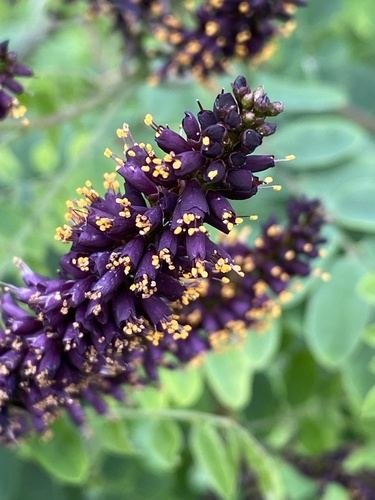
False indigo
Nitrogen-fixing shrub from North America that forms dense thickets along rivers, canals and drains in Thrace, the Marmara region and the Black Sea region, shading out other plants.
How to recognise
Shrub 1-4 m tall; compound leaves with 11-25 small oval leaflets, each with a tiny point; slender spikes of dark violet flowers with bright orange anthers; small curved, dotted pods.
What it tells you about your soil
Moist, sunny river and canal banks, flood plains and wet field edges; tolerates flooding.
Natural control
- Pull seedlings young.
- Cut thickets at the base two or three times each growing season, in early summer and again when regrowth is about 30 cm, for several years; do not cut once and leave.
- Dig out small plants with the crown.
- Mulch or plant fast shade-giving native shrubs or trees (willow, alder, poplar) on cleared banks.
- Remove pods before they ripen and do not move soil or cut material from infested banks to clean land.
- Large stands need long-term effort and cooperation along the whole waterway.
Uses
Honey bees visit the flowers; it has been used for erosion control, windbreaks and as a minor source of dye and fuel. Because it spreads, it is not recommended.
Cautions
Invasive and regulated in several European countries; do not plant it and ask the local agriculture directorate before large clearings along waterways. Seeds and leaves can be mildly poisonous to livestock.