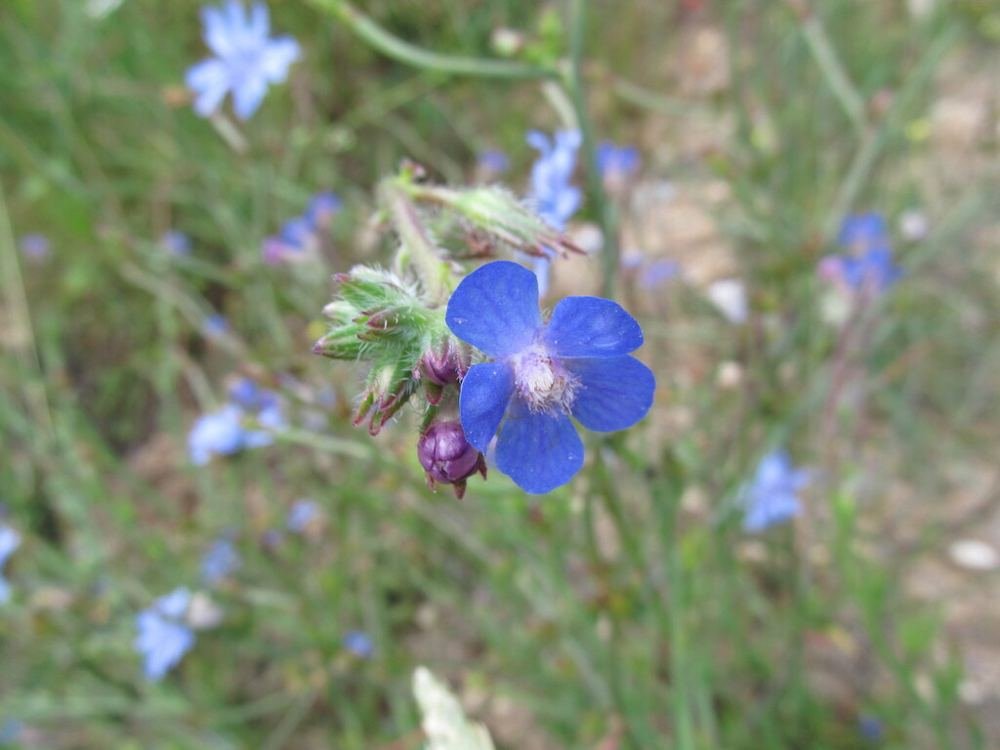
Bugloss and alkanet relatives
Rough-hairy plants of the borage family common in cereals, fallows and field edges; excellent bee plants, but they contain liver-damaging alkaloids.
How to recognise
Bristly, hairy stems and narrow leaves; blue to violet flowers in coiled spikes. Anchusa azurea is tall with deep blue flowers; Echium vulgare (viper's bugloss) has pink buds turning blue; Echium plantagineum has purple-blue flowers; Buglossoides arvensis (corn gromwell) is smaller with white-blue flowers.
What it tells you about your soil
Poor, dry, stony or fallow soils and thin cereals; roadsides and field margins.
Natural control
- Cut or hoe before seed set, and for biennials and perennials cut the root below the crown.
- Sow crops at good density and rotate with row crops.
- Keep a few plants at field edges only where they are not a seed source for fields and hay, as bee plants.
Uses
Young leaves of Anchusa azurea are cooked as a wild green in Turkey and the Mediterranean; all are good nectar plants for bees.
Cautions
Contain pyrrolizidine alkaloids that can damage the liver of horses and cattle; keep out of hay. Eat Anchusa only in modest amounts and not regularly. Bristly hairs can irritate skin, so wear gloves.