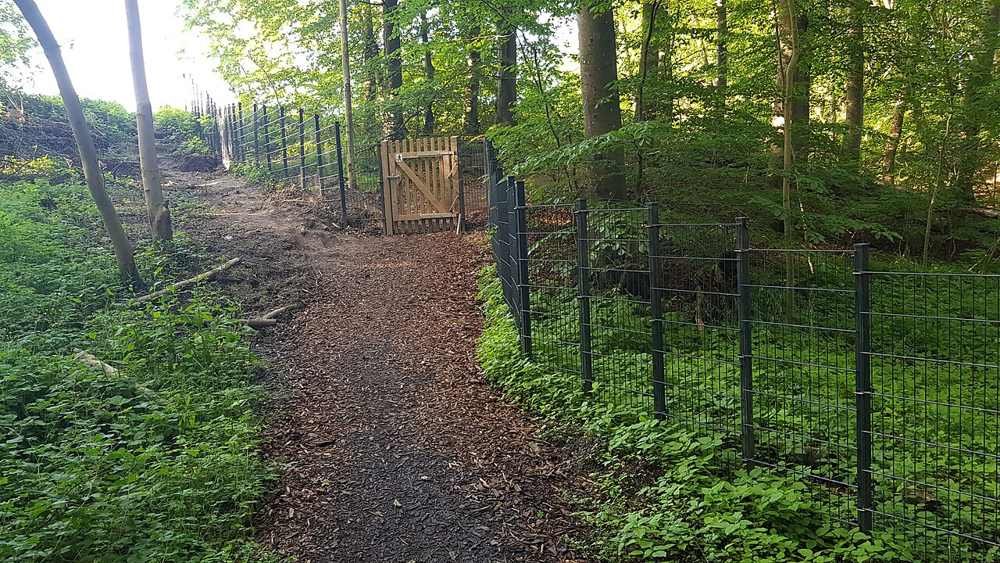
Vertebrate pest deterrents
Physical barriers, scare methods and scents that keep birds, mice, rabbits, deer and wild boar away from crops. Fences and netting are the only methods that work reliably; scents and scare devices give short and uncertain help.
Conditions
Damage rises when fruit is ripening, when natural food is short (dry summers, winter), near forest, hedges and long grass that give cover, and where crops are surrounded by wild land. Animals also learn quickly, so a repellent that works on the first day often stops working after one or two weeks.
What you need
- Bird netting with mesh of about 15 to 20 millimetres, and poles or hoops to hold it off the fruit
- Metal mesh guards (about 6 millimetres) for tree trunks
- Wire mesh (about 25 millimetres) at least 60 centimetres high for rabbit fences
- Tall fence posts and fence for deer (1.8 to 2.4 metres), or welded wire for wild boar
- For an electric fence: charger, insulators, wire, earth stake, warning signs and a voltage tester
- Pegs, ground staples or clips to fix the bottom edge
- Reflective tape or a motion-activated sprinkler (optional)
- Gloves and tools
How to make it
- Watch for signs for a few days and decide which animal is responsible, using tracks, droppings and the type of damage. Check the local wildlife law, because some animals are protected and may not be trapped or harmed.
- For birds on fruit and seedlings, use netting. Choose mesh of about 15 to 20 millimetres and drape it over a frame so it does not touch the fruit. Pull it tight and fix the bottom edge to the ground so birds cannot get in under it. Put it on just before ripening and take it off after harvest.
- For mice and voles at the trunk base, put a guard of fine metal mesh (about 6 millimetres) around the trunk and push it a few centimetres into the soil. Keep grass and mulch away from the trunk and encourage owls and other predators with perches or nest boxes (Habitat: owl & bat boxes, insect hotels, hedgerows).
- For rabbits, use a fence at least 60 centimetres high of wire mesh with openings of about 25 millimetres. Bend 30 centimetres of the bottom outward on the ground, or bury it several centimetres deep, so they cannot dig under.
- For deer, use a fence at least 1.8 to 2.4 metres high that is fixed to the ground, with tight mesh or a double line. A fence that is low or has gaps is quickly jumped or pushed through.
- For wild boar, use a strong welded-wire fence with the bottom fixed to the ground, or an electric fence with low wires at about 20 and 40 centimetres from the ground. Check heights and rules locally, because boar fences vary by country.
- For an electric fence, use a charger made for animals, a good earth stake and warning signs. Keep grass trimmed under the wire so it does not drain the current. Test the voltage weekly with a tester.
- As a short help only, hang reflective tape, move scarecrows often or use a motion-activated sprinkler. Rotate the devices so animals do not get used to them.
- For scent repellents (such as commercial egg-based, predator-urine or soap products), spray on the plant parts you do not eat and renew after rain. Treat them as a small extra, not as a barrier.
- Check fences, netting and guards weekly and repair holes right away. Remove netting and electric wire when the season ends.
- Let some wild land remain at a distance from the crops, so the animals have another food source.
How much it makes
Netting and fences are bought by length or area. A garden of 100 square metres (10 by 10 metres) has a fence line of 40 metres, so a 40-metre roll of mesh, about 20 to 40 posts at 1 to 2 metres apart, and 40 metres of apron. Add about 10 percent extra for corners and gates.
How to use it
- Put netting over fruit just before it ripens and keep the bottom closed.
- Fix rabbit and deer fences into the ground and bend the bottom outward.
- Switch on electric fences at dusk and test them weekly.
- Trim grass under the wires.
- Repeat scent products after rain and rotate scare devices.
- Take the nets and wire away after harvest.
Signs it worked
Know the animal before you choose the method. Birds peck fruit and seedlings and leave open, pecked holes. Mice and voles chew bark at the base of trees, dig up seeds and gnaw root crops. Rabbits cut stems cleanly at an angle and leave round droppings. Deer tear leaves and shoots with a ragged edge, mostly above 0.5 metre, and leave split hoof prints. Wild boar root up the soil in big patches, trample crops and leave muddy rubbing marks on posts. A night camera or sand patch with footprints can confirm which animal it is.
Storage
Roll nets loosely, dry them and store them out of sun and away from mice. Keep electric fence equipment indoors in winter. Store scent repellents in their closed pack, away from children and pets.
If something goes wrong
- Birds still get in: there are gaps at the bottom or the net touches the fruit. Fix the edge to the ground and hold the net away from the fruit.
- Rabbits dig under: the apron is too short or not buried. Add 30 centimetres of mesh bent outward and bury it.
- Deer jump the fence: it is too low. Raise it to at least 1.8 metres or add a second fence line.
- Wild boar push through: the fence is weak or loose at the bottom. Use stronger wire and fix it to the ground or add low electric wires.
- Electric fence is weak: grass touches the wires or the earth is poor. Clear the grass and add or moisten the earth stake.
- Repellent stopped working after a week: the animals have got used to it. Move or rotate the devices, and rely on a fence.
Cautions
Never use poison baits or traps that harm other animals; poison can kill pets, birds of prey and other wildlife. Check local law before trapping, culling, or using electric fences; electric fences must have warning signs and should be installed so that people and children cannot be trapped. Netting that is loose can trap and kill birds, bats and snakes, so keep it tight and inspect it daily. Do not spray repellents on edible parts close to harvest, and follow the product label. Deer and boar fences must not block roads or the paths used by other wildlife without permission. Evidence for scent repellents and scare devices is weak: they are short-lived.