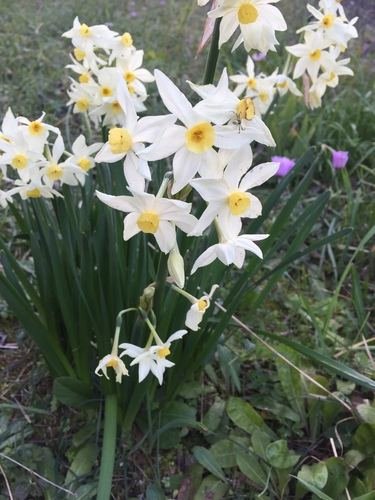
Paperwhite & poet's narcissus
Two scented narcissus species from the Mediterranean region and Turkey. Narcissus tazetta carries clusters of 3-8 small white flowers with yellow cups, 25-45 cm tall, in winter to early spring; the pure white forms called paperwhite are usually Narcissus papyraceus, a close relative grown the same way. Narcissus poeticus has single white flowers with a small red-rimmed yellow eye on 30-45 cm stems in April to May. Both grow wild in Turkey. Used in beds, pots, naturalised in grass and as scented cut flowers. Poisonous: see Care.
Planting
Plant 8-12 cm deep (three times the bulb height), pointed end up, 10-15 cm apart; in grass, scatter and plant where they fall. In pots use free-draining potting mix with bulbs nearly touching. Propagate by lifting crowded clumps after the leaves yellow and separating offsets.
Site & soil
Full sun to light shade under deciduous trees. Tazetta likes light, well-drained soil that is dry in summer; poet's narcissus tolerates heavier, spring-moist soil. Neutral to slightly alkaline is fine.
Watering
Water after planting and in dry spells while the leaves grow. Keep fairly dry in summer. Yellow leaves in spring with a soft bulb mean rot.
Natural feeding plan
- Light feeding.
- Work compost into the bed at planting and mix in a little Microbe-rich soil mix (IMO-4).
- Give Fermented plant juice (FPJ) 1:1000 (1 ml in 1 litre of water) once the shoots are up, then Eggshell calcium in vinegar (WCa) (water-soluble calcium) 1:1000 (1 ml in 1 litre of water) or a potash-rich plant ferment 1:1000 (1 ml in 1 litre of water) after flowering while the leaves are green, so the bulb refills.
- Do not feed while dormant.
Care through the season
Deadhead, but let the leaves die back naturally (about 6 weeks); do not tie or cut them early. Divide crowded clumps every 3-5 years after the leaves yellow. Deer, rabbits and rodents generally leave them alone. Toxic: all parts, especially the bulbs, are poisonous to people, dogs, cats and livestock; the sap irritates skin. Bulbs have been mistaken for onions, so never plant them near edible bulbs.
Harvest
Cutting and using: cut in bud with the first colour showing; vase life 4-7 days. The sap harms other flowers, so stand cut stems alone in water for 12 hours before mixing. Strongly scented, and used in perfume. Bulbs are best left in the ground; lift and divide in summer if needed and store dry and shaded.
More growing tips
- Light: full sun to part shade.
- Temperature: tazetta hardy to about -10 °C; poet's narcissus to about -34 °C.
- Flowering time: tazetta late autumn to early spring; poet's narcissus April to May.
- Height and spread: 25-45 cm tall, clumps spread slowly.
- Propagation: offsets by division after the leaves die back.
- Toxicity: poisonous to people, dogs, cats and livestock; sap irritates skin.
- Lifespan: long-lived perennial, decades when left undisturbed.
Common problems
Background sources: the California Master Gardener Handbook and the Royal Horticultural Society. See Sources and references. Talk transcripts on perennials and summer pruning: see Sources and references.