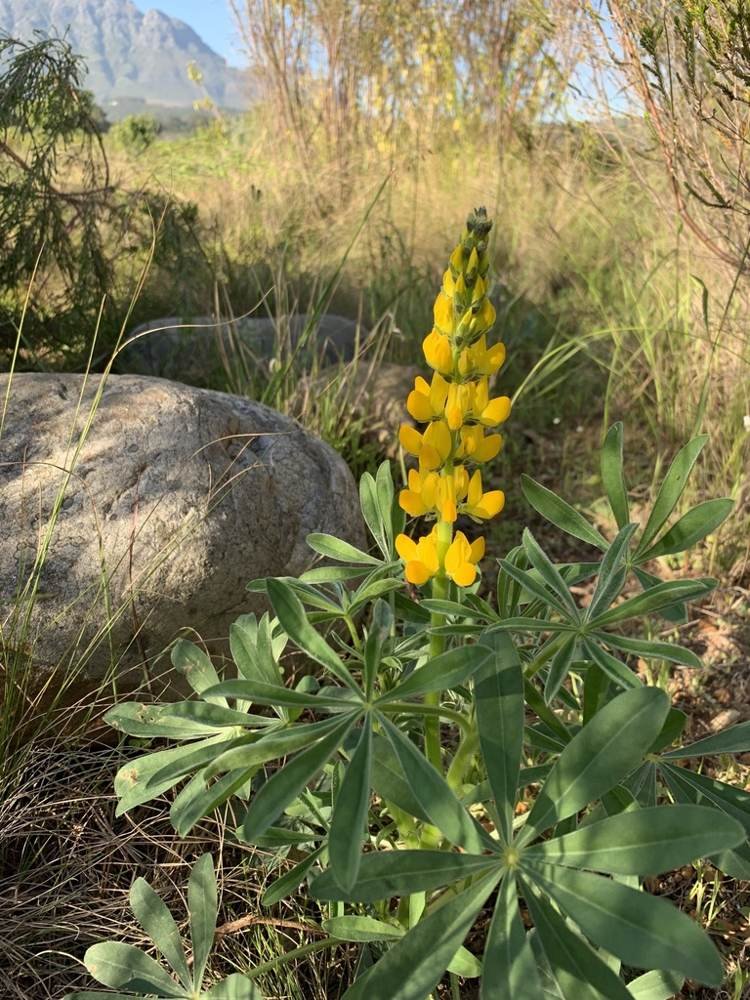
Yellow lupin
Annual lupin, 30-80 cm tall, with palmate leaves and upright spikes of scented yellow flowers. It is grown in Poland, Germany, Russia, Spain and Australia for protein-rich seed (animal feed, increasingly food) and as a green manure on acidic sandy soils. It has the highest protein of the lupins. Safety: wild and bitter types have alkaloids and the seed is toxic; grow only sweet (low-alkaloid) varieties for food or feed, and never eat bitter seed unless it has been soaked and processed. Warning: it escapes and naturalises on sandy soils in places such as South Africa and Australia, so avoid sowing it next to natural vegetation there.
Planting
Sowing seed in the ground
Sow thinly in a row, 3-4 cm deep. Thin the seedlings to the spacing given below.
Spacing and thinning
Sow 3-4 cm deep in rows 25-30 cm apart, about 15-20 cm between seeds in the row (about 100-150 kg of seed per hectare, 10-15 g per m²). Inoculate seed with lupin Rhizobium seed pelleting on new ground; the common bean and clover strains do not work.
Site & soil
Full sun; light, well-drained, acidic to neutral sandy soil (pH 5-6.5). Avoid limy soil, where plants turn yellow and stunted (lime-induced chlorosis).
Watering
Mostly rain-fed; avoid waterlogging. Water lightly in dry spells at flowering and pod fill.
Natural feeding plan
- No extra nitrogen: legumes make their own.
- Coat seed with Rhizobium seed pelleting on new ground.
- Skip lime and fresh manure; compost or Microbe-rich soil mix (IMO-4) 'Microbe-rich soil mix (IMO-4)' before sowing; Fermented plant juice (FPJ) 1:1000 (1 ml in 1 litre of water) in early growth; Bone calcium-phosphorus in vinegar (WCaP) 1:1000 (1 ml in 1 litre of water) at flowering.
Care through the season
Keep weeds down in the first weeks, because seedlings grow slowly. Grow only sweet (low-alkaloid) varieties for food or feed. Do not graze animals on bitter wild or ornamental lupin plants. Rotate with cereals and do not sow lupins again on the same field for 4 years. For green manure, chop and leave the tops on the surface at flowering.
Harvest
Cut or pull when the pods turn brown and the seeds rattle (June-July); pods shatter, so harvest promptly. Dry and thresh. Yield is about 1.5-3 tonnes of seed per hectare.