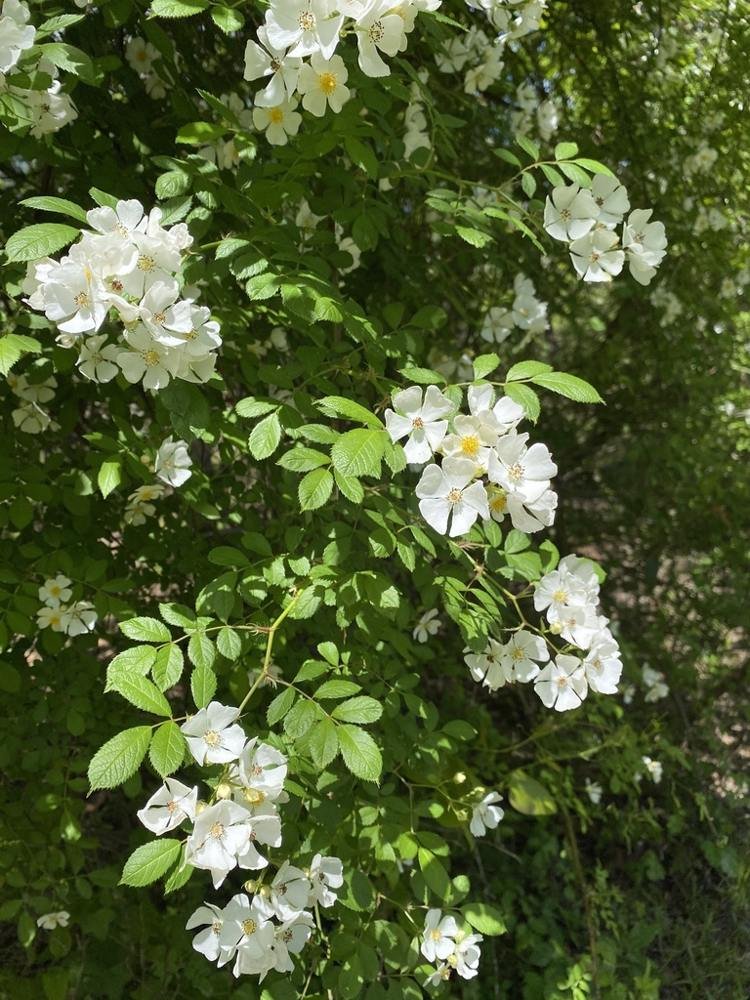
Multiflora rose
Vigorous, arching, thorny deciduous shrub, 2-4 m tall and wide, with clusters of many small white to pale pink, sweetly scented flowers in late spring and masses of small red hips in autumn. Native to East Asia (Japan, Korea, eastern China). Once planted as a living fence and as the rootstock for garden roses, it is now a serious invasive weed in much of eastern North America and parts of Europe, where one plant can make 500,000 seeds a year that stay alive in the soil for 10-20 years. Warning: it is a listed noxious weed in several United States states. Check local rules and do not plant it near wild land; consider native roses such as dog rose (Rosa canina) instead.
Planting
Only plant where a contained, managed hedge is wanted and local rules allow. Space 0.5-1 m apart for a thick living fence; dig a hole as deep as the roots, firm, water in and mulch with straw. Keep away from pasture, woodland edges, streams and nature reserves. Do not plant it next to wild land.
Site & soil
Almost any soil, moist to dry, from slightly acid to alkaline. Full sun for the best flowering; tolerates part shade. Does badly in permanently wet soil.
Watering
Water in the first year only. Established plants need none, except in long droughts.
Pollination & reproduction
Flowers have both sexes and are pollinated by bees and other insects; plants also self-pollinate. A large shrub can make up to 500,000 seeds a year, which stay alive in the soil for 10-20 years, and birds and mammals spread them far. Plants also spread by suckers and by arching canes that root at the tips. Warning: this is why it is invasive; do not plant it near wild land and remove seedlings promptly.
Natural feeding plan
- No feeding needed.
- A mulch of compost or leaf litter in autumn is enough.
- No chemical fertilisers.
Care through the season
Cut back hard after flowering to keep it dense and to stop hips forming; remove all hips before they ripen to prevent birds from spreading seed. Dig out suckers and arching stems that root where they touch soil. Cut and remove seedlings early: pull small ones, dig out the roots of larger ones, and cut regrowth 3-6 times a year for several years. Wear thick gloves; stems have curved prickles. Rose rosette disease, a virus spread by a mite, can kill plants in North America.
Harvest
Not harvested for food. Hips are small and eaten by birds, which spread them. The flowers give nectar and pollen to bees in late spring. Burn or Hot compost (15-day method) cut stems and hips so they cannot root or seed; do not put them in the open compost heap.
More growing tips
- Time to maturity: 2-3 years to a dense hedge; flowers from the second or third year.
- Growth rate and size: fast, up to 1 m a year, reaching 2-4 m tall and wide.
- Lifespan: 20-40 years or more; it regrows from the stump and roots.
- Propagation: hardwood or softwood cuttings root easily; seed needs 2-3 months of cold stratification; arching stems root where they touch the ground.
- Wildlife and other uses: flowers for bees; hips for birds and small mammals, which spread the seed; thorny cover for nesting; widely used as the rootstock for grafted garden roses.