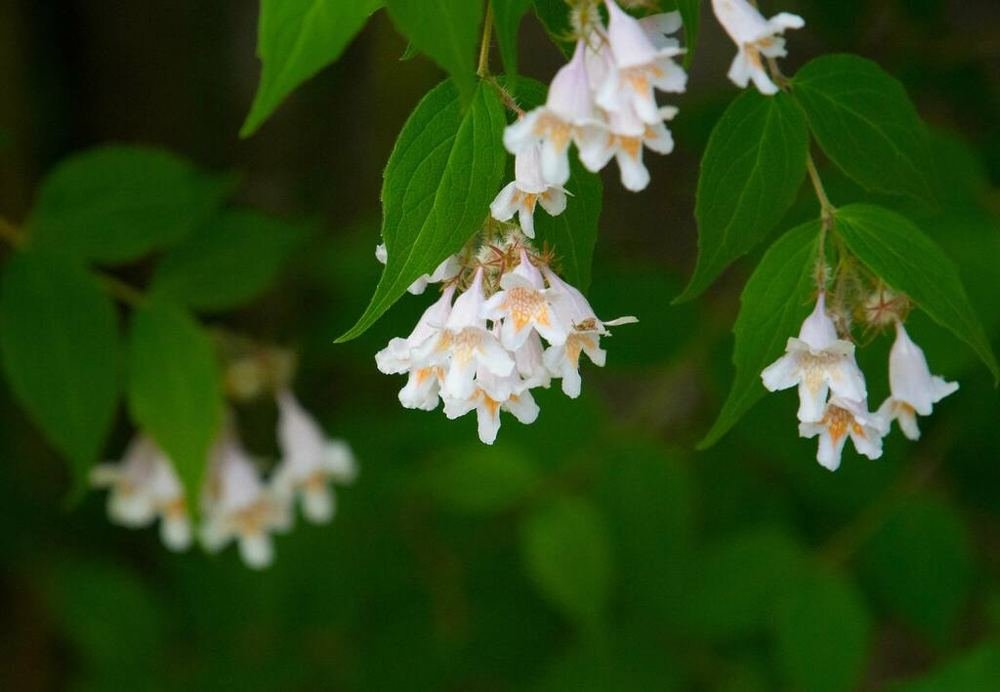
Beauty bush
Graceful deciduous shrub 2-3 m tall and wide with arching stems, peeling bark and masses of pink bell-shaped flowers with yellow throats in late spring, followed by bristly seed capsules. Native to central China. A showy, trouble-free shrub for hedgerows and mixed borders, valued as a nectar source for bees and butterflies.
Planting
Space 2-3 m apart, or 1.5 m for a loose hedge. Dig a hole as deep as the root ball and twice as wide, water well and mulch with leaves or straw.
Site & soil
Any well-drained soil, including poor, chalky or stony soil. Needs full sun for the best flowering; light shade is tolerated. Avoid waterlogged ground.
Watering
Water young plants through the first dry summer. Established shrubs are fairly drought tolerant.
Pollination & reproduction
Flowers are perfect (both sexes) and are pollinated by bees and other insects. It sets seed freely but seldom seeds itself aggressively. Propagated mainly by cuttings, or by seed.
Natural feeding plan
- Usually no feeding needed.
- Mulch with compost or leaf litter in autumn; a little Fermented plant juice (FPJ) 1:1000 (1 ml in 1 litre of water) in spring is enough.
- Rich feeding gives leaves instead of flowers.
- No chemical fertilisers.
Care through the season
Prune lightly after flowering: remove a few of the oldest stems at the base each year to keep the shrub open and flowering. It flowers on older wood, so do not cut it hard every year. Not invasive and not toxic.
Harvest
Not a food or timber plant. Cut flowering stems for the vase, or cut old stems for light stakes and bean poles. Leave the flowers for bees and the seed capsules for birds.
More growing tips
- Time to maturity: 3-5 years to a full flowering shrub.
- Growth rate and size: moderate; 2-3 m tall and wide, vase-shaped.
- Lifespan: 30-50 years or more.
- Propagation: softwood cuttings in early summer, hardwood cuttings in winter, or seed sown in autumn.
- Wildlife and other uses: nectar for bees and butterflies, cover for small birds, ornamental hedge.